The Case for Being Bad at Something
Much of what we believe we are "bad at" is not a lack of ability but a mismatch with one narrow definition of the activity — and beginning something new in midlife is often the act of discovering the version of it that is actually ours.
Why the thing you gave up on at sixteen may not have been the thing at all — and why this is the decade to find out.
Most of us are carrying around a list of things we are bad at.
It is a quiet list, rarely spoken aloud, but it governs more than we admit. I can't draw. I'm not musical. I have no sense of direction. I can't dance. We recite these the way we recite our birthdays — as settled facts, as parts of the furniture of who we are. And because they feel like facts, we never test them. The list does its work precisely by never being examined.
Here is what I have come to believe about that list. Most of the items on it are not true. Or rather, they are true only in the narrowest, most literal sense — and that narrow truth has been quietly standing in for a much larger lie.
The thing you were bad at was probably one version of the thing
Consider the most common entry on everyone's list: I can't draw.
What does it actually mean? Almost always, it means: at some point, usually in childhood, I tried to draw something — a horse, a face, a bowl of fruit — so that it looked like the thing in front of me. And it didn't. The horse looked wrong. Someone, possibly me, concluded that I was bad at art, and the door closed.
But notice what just happened. "Art" got quietly replaced with one specific, demanding, technical version of art: representational drawing. The ability to render a three-dimensional object on a flat surface so that it reads as accurate. That is a real skill, and it is hard, and plenty of people are not naturally good at it.
But it is not art. It is one corner of one room of an enormous house. There is color. There is abstraction. There is texture and gesture and feeling and the thousand things a mark on a page can do that have nothing to do with making a horse look like a horse. To decide you are "bad at art" because you cannot draw an accurate horse is like deciding you are bad at language because you cannot write a sonnet. The conclusion vastly overreaches the evidence.
To decide you are bad at art because you cannot draw an accurate horse is like deciding you are bad at language because you cannot write a sonnet.
And yet we do it constantly. We take one bad experience with one narrow version of a thing and we generalize it into a permanent identity. I can't draw becomes I'm not artistic becomes a closed door we walk past for forty years.
What "being good" was secretly being measured against
The deeper trap is the standard we were measuring against without realizing it. When you decided you were bad at art, you were measuring against accuracy. When you decided you were unmusical, you were probably measuring against performance. In every case, "good" was defined as technical mastery of a public, judgeable standard — exactly the wrong question to ask of a thing you would be doing for yourself, for pleasure, for no audience at all.
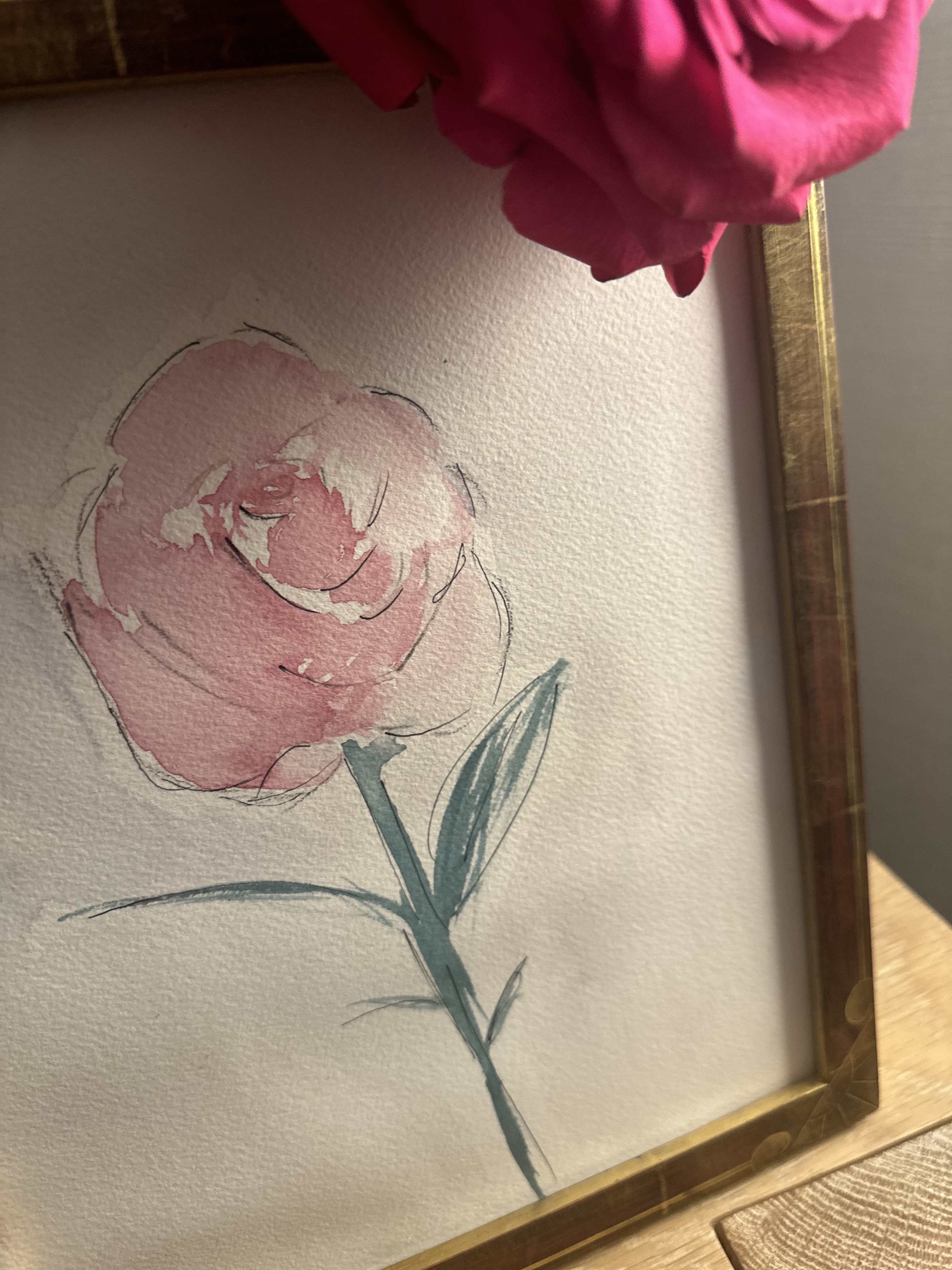
The watercolor that captures how a flower feels rather than how it looks is not a failed botanical illustration. It is a different and entirely legitimate aim. The piano played imperfectly in your own living room is not a failed concert. The point was never the concert. So when we say "I'm bad at it," what we often mean is: I am bad at the one version of this that comes with a grade. Which may be true, and which may also be completely irrelevant to whether there is a version of it that is yours.
Beginning as discovery
This reframes what it means to begin something new in this decade. We tend to think of taking up a new pursuit as a test we will probably fail. But the more useful frame is that beginning is an act of discovery. You are not finding out whether you can meet a standard. You are finding out which version of the thing fits you.
You are not finding out whether you can meet a standard. You are finding out which version of the thing fits you.
You try drawing and discover you don't care about accuracy but you are riveted by color. You try the piano and find you have no patience for sheet music but you love improvising. None of these are failures at the original thing. They are the sound of you locating the version that is actually yours — which you could only ever have found by starting. And here is the part the culture gets backwards: this is easier now, not harder. With less to prove and no one keeping score, you are finally free to begin badly, follow what interests you rather than what impresses, and pay no attention at all to whether it would pass.
What the science says you get, regardless
There is also a more clinical case, and it removes the last excuse. In Your Brain on Art, Susan Magsamen of Johns Hopkins and Ivy Ross synthesize the emerging research of neuroaesthetics — the study of what measurably happens in the brain and body during creative and novel experience. Making art for as little as forty-five minutes measurably lowers cortisol, the body's primary stress hormone — and the effect holds regardless of skill level. You do not have to be good. The benefit is in the doing.
Novelty itself is the active ingredient. When you do something genuinely unfamiliar, the brain stops running on automatic and starts building — forming new connections, staying plastic and engaged. Which means the very thing we avoid — being a beginner, being bad, doing the unfamiliar — is precisely the thing that keeps the mind alive.
The permission
So here is the permission, since the list will not lift on its own. The things you are "bad at" deserve a second hearing. Not all of them — some you genuinely have no pull toward, and that is fine. But the ones that come with a small pang of wistfulness, the ones where "I can't" is shadowed by "I always wished I could" — those were almost certainly never given a fair trial. They were tried once, in one narrow form, against one unforgiving standard, and then filed away as settled.
They are not settled. You are allowed to reopen any of them. You are allowed to discover that you were never bad at the thing — only mismatched with one version of it, forty years ago, by a standard that was never the point.
You may not be bad at it at all. You may simply never have found your way in.